


Introduction
Most people know what emotional intelligence is. Few people actually have it.
Reading about it is not the same as developing it. But the right book changes that. It gives you a framework for emotions you have been reacting to blindly for years and tools to respond to them differently.
These 12 books do exactly that. Each one targets a different part of emotional intelligence: self-awareness, empathy, emotional regulation, relationships, and leadership. Pick the one that matches where you struggle most.
What Are the Best Books for Emotional Intelligence?
The best books for emotional intelligence give you specific, science-backed tools to understand your own emotions and the emotions of others. They go beyond theory and show you how emotional awareness changes decisions, relationships, and performance in real situations.
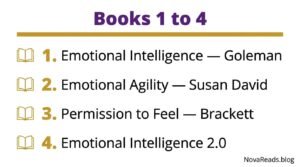
1. Emotional Intelligence by Daniel Goleman
Best for: Understanding the foundation of EQ
This is where emotional intelligence as a concept entered mainstream conversation. Goleman argues that EQ matters more than IQ in determining life outcomes — and backs that claim with neuroscience and behavioral research.
He breaks EQ into 5 components: self-awareness, self-regulation, motivation, empathy, and social skills. Each one is explained with real examples drawn from education, leadership, and relationships.
This is not a quick fix book. It is a foundational text. Read it first. Everything else makes more sense after it.
Who should read it: Anyone starting their emotional intelligence journey who wants the science behind the concept, not just the advice.
2. Emotional Agility by Susan David
Best for: Handling difficult emotions without being consumed by them
David’s core argument is simple and powerful. You cannot think your way out of an emotion. But you can unhook from it.
Emotional agility is the ability to face your thoughts and feelings with curiosity instead of avoidance or judgment. David gives a
4-step process: showing up, stepping out, walking your why, and moving on. Each step has specific exercises.
This book stays with you. Not because it is dramatic. Because it describes something you have been doing wrong for years — and shows you a better way.
Who should read it: People who either suppress their emotions or get completely overwhelmed by them.
3. Permission to Feel by Marc Brackett
Best for: Building emotional vocabulary
Brackett is the director of the Yale Center for Emotional Intelligence. His argument: most people cannot accurately name what they are feeling. And you cannot manage what you cannot name.
His RULER framework — Recognizing, Understanding, Labeling, Expressing, and Regulating emotions — gives readers a practical system for emotional awareness. The book includes an emotion meter called the Mood Meter, which maps emotions across energy and pleasantness.
Most emotional intelligence books tell you to manage your emotions. This one teaches you to understand them first.
Who should read it: Parents, teachers, and anyone who struggles to identify what they are actually feeling in a difficult moment.
4. Emotional Intelligence 2.0 by Travis Bradberry and Jean Greaves
Best for: Practical EQ improvement with measurable results
This is the most action-oriented book on this list. Bradberry and Greaves provide an online EQ assessment, then give 66 specific strategies organized across 4 EQ skills: self-awareness, self-management, social awareness, and relationship management.
You do not read this book cover to cover. You take the test, identify your weakest skill, and apply the relevant strategies. The approach is direct and results-focused.
It is not the deepest book on emotional intelligence. But it may be the most immediately useful.
Who should read it: People who want a structured, measurable approach to improving EQ rather than a theoretical exploration.
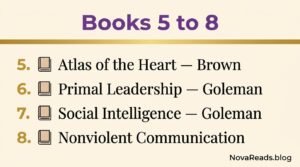
5. Atlas of the Heart by Brené Brown
Best for: Expanding emotional vocabulary and understanding relationships
Brown maps 87 emotions and experiences — many of which most people have felt but never had language for. Foreboding joy. Comparative suffering. Anguish. Awe.
Having words for emotions is not a small thing. Research shows that precise emotional labeling reduces the intensity of those emotions. Naming what you feel literally changes how you feel it.
This book expands your emotional vocabulary in a way that changes how you navigate every relationship in your life.
Who should read it: Anyone who feels emotions strongly but struggles to articulate them accurately.
6. Primal Leadership by Daniel Goleman, Richard Boyatzis, and Annie McKee
Best for: Emotional intelligence in leadership
This book makes one central argument: a leader’s primary job is to manage the emotional climate of their team. Emotions are contagious. When leaders bring positive emotional energy, teams perform better, trust more, and grow faster.
Goleman and his co-authors call this resonant leadership. They contrast it with dissonant leadership — which drains team energy regardless of how technically competent the leader is.
In 2026, with remote work creating emotional distance in teams, this book is more relevant than ever.
Who should read it: Managers, executives, and anyone in a position where their emotional state directly affects other people’s performance.
7. Social Intelligence by Daniel Goleman
Best for: Understanding how relationships shape your brain
Goleman’s follow-up to Emotional Intelligence focuses on the social dimension of EQ. He examines how the brain reads social cues, how empathy is built neurologically, and how our relationships literally shape our brain health over time.
His most important finding: face-to-face connection activates neural circuits that digital communication cannot replicate. In an era of screens and remote work, that matters enormously.
Who should read it: People who feel disconnected in relationships or who want to understand the neuroscience behind empathy and social bonding.
8. Nonviolent Communication by Marshall Rosenberg
Best for: Transforming difficult conversations
Rosenberg’s framework reduces conflict to 4 steps: observations, feelings, needs, and requests. The idea is to separate what you observe from what you evaluate — and to communicate needs directly instead of through blame or judgment.
It sounds simple. It is not easy. But couples, parents, managers, and diplomats who practice it report dramatically fewer conflicts and faster resolution when conflicts do arise.
This is the most practical relationship book on this list. Every difficult conversation in your life becomes more manageable after you read it.
Who should read it: Anyone who finds themselves in frequent conflict, or who wants to communicate more effectively in high-stakes personal or professional relationships.
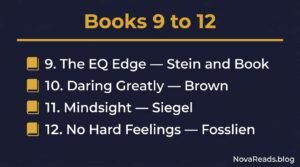
9. The EQ Edge by Steven Stein and Howard Book
Best for: Applying EQ in professional settings
Stein and Book connect emotional intelligence directly to career performance. They show how EQ predicts success across industries — from sales to nursing to military leadership — and give specific strategies for each EQ component in a workplace context.
The book draws on data from over 42,000 people assessed using the EQ-i assessment tool. That research base gives the advice more weight than most self-help books carry.
Who should read it: Professionals who want to understand how emotional intelligence specifically affects career outcomes — not just personal wellbeing.
10. Daring Greatly by Brené Brown
Best for: Vulnerability as emotional strength
Brown’s most influential book reframes vulnerability not as weakness but as the foundation of connection, creativity, and courage. Her research shows that people who allow themselves to be vulnerable experience deeper relationships, stronger leadership, and greater creativity.
The emotional intelligence connection: people with high EQ are not less vulnerable. They are more willing to be vulnerable — because they trust their ability to handle whatever emotions arise.
Who should read it: People who confuse emotional control with emotional strength, or who avoid vulnerability to protect themselves from connection.
11. Mindsight by Daniel Siegel
Best for: Understanding the neuroscience of emotional regulation
Siegel introduces the concept of mindsight — the ability to observe your own mind from a slight distance, without being swept away by it. He explains the neuroscience of how trauma, stress, and relationships shape the brain — and how that shaping can be changed.
This is the most neuroscience-heavy book on this list. It is also the most transformative for people who have struggled with emotional regulation despite wanting to change.
Who should read it: People who feel controlled by their emotional reactions despite genuinely wanting to respond differently.
12. No Hard Feelings by Liz Fosslien and Mollie West Duffy
Best for: Emotional intelligence at work in plain language
This book makes workplace emotional intelligence accessible, practical, and even funny. Fosslien and Duffy cover how to handle emotions at work — from managing anxiety about performance to navigating office politics to dealing with difficult colleagues.
The illustrations throughout make complex ideas easy to absorb. It is the least academic book on this list and one of the most immediately useful for anyone navigating a workplace in 2026.
Who should read it: Anyone who struggles to manage emotions at work or who wants a lighter entry point into the emotional intelligence conversation.
Which Book Should You Start With?
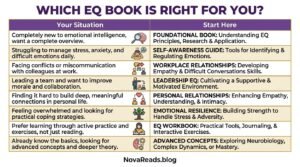
| Your Situation | Start Here |
|---|---|
| New to EQ | Emotional Intelligence by Goleman |
| Want practical tools | Emotional Intelligence 2.0 |
| Struggle to name emotions | Permission to Feel |
| Leadership role | Primal Leadership |
| Difficult relationships | Nonviolent Communication |
| Overwhelmed by emotions | Emotional Agility |
| Want neuroscience | Mindsight |
| Workplace focus | No Hard Feelings |
What is the best book for emotional intelligence beginners?
Start with Emotional Intelligence by Daniel Goleman. It explains what EQ is, why it matters more than IQ in many life situations, and how it works neurologically. After reading it, every other book on emotional intelligence makes more sense.
Can books actually improve emotional intelligence?
Yes — but only with practice. Reading about emotional awareness creates understanding. Applying one technique consistently creates change. Pick one exercise from whichever book you read and practice it for 30 days before moving on.
What is the difference between emotional intelligence and IQ?
IQ measures cognitive ability how fast you process information and solve abstract problems. EQ measures your ability to recognize, understand, manage, and use emotions effectively. Research by Daniel Goleman and others shows EQ predicts success in relationships, leadership, and wellbeing more reliably than IQ alone.
Which emotional intelligence book is best for leaders?
Primal Leadership by Goleman, Boyatzis, and McKee is the most focused on leadership specifically. It explains how a leader’s emotional state directly affects team performance and gives a framework for developing resonant leadership.
How long does it take to improve emotional intelligence?
Research suggests meaningful EQ improvement takes 3 to 6 months of consistent practice. Unlike IQ, EQ is developable at any age. The neural pathways involved in emotional regulation are plastic they change with repeated experience and deliberate practice.
What is emotional agility and why does it matter?
Emotional agility, a concept developed by Susan David, is the ability to engage with your emotions with curiosity and flexibility rather than avoidance or rigid control. It matters because suppressing or avoiding emotions increases their intensity over time, while engaging with them thoughtfully reduces their power.
Which emotional intelligence book is best for relationships?
Nonviolent Communication by Marshall Rosenberg is the most practical for improving specific relationships. Atlas of the Heart by Brené Brown is best for understanding the emotional landscape of relationships more broadly.
Is emotional intelligence genetic or learned?
Largely learned. While temperament has a genetic component, the skills that make up EQ empathy, emotional regulation, self-awareness are developable through practice and experience. The brain’s plasticity means EQ can be improved at any stage of life.
What is the RULER framework from Permission to Feel?
RULER stands for Recognizing, Understanding, Labeling, Expressing, and Regulating emotions. Developed by Marc Brackett at the Yale Center for Emotional Intelligence, it is a structured approach to emotional literacy that has been implemented in thousands of schools and workplaces worldwide.
Do emotional intelligence books work for introverts?
Yes. Emotional intelligence is not about being outgoing or socially dominant. It is about understanding and managing emotions — your own and others’. Introverts often have high self-awareness, which is one of the core components of EQ. Books like Emotional Agility and Mindsight are particularly well-suited to introverted readers.