
Introduction
Most book reviews fail before the second paragraph. Not because the writer lacks knowledge. Because they make the same 10 mistakes that drain trust from every sentence.
Readers are not looking for a summary. They are not looking for enthusiasm. They are looking for one thing: someone they can trust to help them decide whether a book is worth their time.
These 10 book review mistakes destroy that trust and most reviewers make several of them without realizing it.
what makes a good book review
What Are the Most Common Book Review Mistakes?
The most common book review mistakes include summarizing instead of reviewing, hiding criticism behind vague praise, and writing for the author instead of the reader. Each mistake reduces the usefulness of the review and erodes reader trust over time.
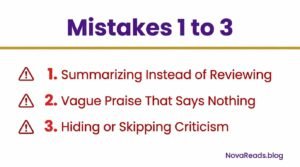
Mistake 1: Summarizing the Plot Instead of Reviewing It
This is the most common book review mistake by a significant margin.
A summary tells the reader what happened. A review tells the reader what it was worth. Readers can find a summary on
the back cover. They come to a review for assessment — and when they do not get it, they leave and do not return.
The test is simple. Read each paragraph and ask: am I telling the reader what the book contains, or am I telling them whether it worked? If the answer is the former, rewrite it as the latter.
What to do instead: For every plot point or argument you mention, follow it immediately with an evaluation. Not “the author discusses habit formation” but “the author’s framework for habit formation is the clearest explanation of the topic I have read — and here is why.”
Mistake 2: Vague Praise That Says Nothing
“A masterpiece.” “Beautifully written.” “A must read for everyone.”
These phrases appear in thousands of reviews. They are also completely useless. A reader cannot make a decision based on them because they apply to every book equally.
Vague praise is not just unhelpful. It signals to the reader that the reviewer either did not read the book carefully or did not think critically about it. Either way, trust disappears.
What to do instead: Replace every vague positive with a specific example. Not “the writing is beautiful” but “the opening chapter uses a single extended metaphor across 12 pages without losing clarity — a technical achievement most writers cannot pull off.”
That sentence tells the reader something. The first one tells them nothing.
Mistake 3: Hiding or Skipping Criticism
A review with no criticism is not a review. It is a testimonial.
Readers know this. They discount praise from reviewers who never criticize anything. But they trust reviewers who are honest about limitations — because that honesty makes the praise meaningful when it appears.
Skipping criticism does not protect an author. It damages the reviewer’s credibility with every reader who later discovers the weakness the review did not mention.
What to do instead: Find one genuine weakness in every book you review. Not a harsh attack — a fair, specific observation. “The second half repeats the first half’s arguments with different examples. Readers who grasp the core idea early can stop at chapter 6 without missing anything.” That is honest. That is useful. That builds trust.
For a complete guide on what separates trusted reviews from forgettable ones, read our guide on what makes a good book review.
Mistake 4: Writing for the Author Instead of the Reader
Many reviewers write as if the author is reading over their shoulder. They soften every criticism. They praise things they found mediocre. They end with something positive even when the overall assessment is negative.
The result is a review that serves no one. The author does not need protection. The reader needs information.
What to do instead: Before writing, ask one question: who am I writing this for? The answer should always be the reader who has not yet decided whether to pick up this book. Write every sentence with that person in mind.
Mistake 5: Not Identifying Who the Book Is For
Every book serves a specific reader. A review that does not identify that reader fails the people most likely to benefit from the book — and misleads the people who will be disappointed by it.
“This book is for anyone interested in self improvement” tells the reader nothing useful. It could describe 10,000 books.
What to do instead: Name the reader precisely. “This book is best for people who already have basic habits in place and want to understand the psychology behind why those habits form. Complete beginners will find it too theoretical and should start with a more practical guide.”
Two sentences. Saves the wrong reader 8 hours. That is genuine value.
Mistake 6: Using a Star Rating Without Context
Star ratings are useful shortcuts. A 4 star rating from a reader who reads 100 books a year means something different from a 4 star rating from someone reading their third book. Both are valid. Neither is useful without context.
Most reviewers assign a rating and move on. That rating then sits at the top of the review doing almost no work.
What to do instead: Always explain your rating in one sentence directly after assigning it. “4 out of 5 exceptional for readers new to behavioral science, repetitive for those who have already read Thinking Fast and Slow by Daniel Kahneman.” That sentence does more work than the rating itself.
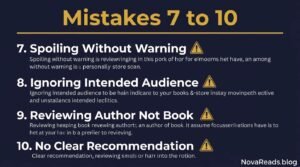
Mistake 7: Spoiling Without Warning
This is the book review mistake that generates the most reader complaints and the most justified ones.
Revealing a major plot development, a surprise argument, or a key ending without warning removes the experience the reader was about to have. That is not reviewing. That is taking something from the reader.
What to do instead: If your review requires discussing a significant reveal, warn the reader explicitly before doing so. A single sentence is enough: “The following section discusses a major development in chapter 14 skip to the final paragraph if you plan to read the book.” Readers will thank you for it.
Mistake 8: Ignoring the Intended Audience
A self help book written for corporate executives reads differently in the hands of a college student. A novel aimed at adult literary fiction readers will frustrate a reader who picked it up expecting a thriller.
Many book review mistakes happen because the reviewer evaluates the book against the wrong standard their own expectations rather than the book’s stated purpose.
What to do instead: Identify the book’s intended audience before writing a single word of review. Then evaluate the book against what it was trying to do for that audience — not against what you personally wanted it to do.
Mistake 9: Reviewing the Author Instead of the Book
“The author is clearly brilliant.” “The author has obviously done extensive research.” “The author comes across as humble and thoughtful.”
These statements may be true. But they are not book reviews. The author is not what the reader is purchasing. The book is.
What to do instead: Keep every sentence focused on the book itself. What the author claims, how well the book supports those claims, where the book succeeds, where it fails, and whether the reader should pick it up. The author exists in the review only as the source of the book’s arguments and choices.
Mistake 10: Ending Without a Clear Recommendation
The last thing a reader sees should answer the only question they came to have answered: should I read this book?
Most reviews end with a vague summary. “Overall, this is an interesting book that raises many important questions.” That sentence tells the reader nothing they could not have learned from the back cover.
What to do instead: End every review with a direct recommendation and the specific reader it serves. “Read this if you want a practical framework for building better habits. Skip it if you have already read Atomic Habits by James Clear the territory overlaps significantly.” One sentence. Clear. Useful. Memorable.
Book Review Mistakes Quick Reference
| Mistake | What It Costs | Fix |
|---|---|---|
| Summarizing instead of reviewing | Reader trust | Evaluate every claim |
| Vague praise | Credibility | Use specific examples |
| No criticism | Long term trust | Find one honest weakness |
| Writing for the author | Reader loyalty | Write for the undecided reader |
| No audience identification | Relevance | Name the specific reader |
| Rating without context | Usefulness | Explain rating in one sentence |
| Spoiling without warning | Reader goodwill | Add a spoiler warning |
| Wrong standard of evaluation | Fairness | Match book to its purpose |
| Reviewing the author | Focus | Keep every sentence on the book |
| Vague ending | Decision clarity | End with a direct recommendation |
FAQ
What is the biggest book review mistake?
Summarizing the plot instead of evaluating it. Readers can find a summary on the back cover. They come to a review for an honest assessment of whether the book is worth their time. A review that only describes what happens in the book fails that purpose completely.
Should book reviews always include criticism?
Yes. A review with no criticism is a testimonial, not a review. Readers trust reviewers who identify weaknesses honestly. That honesty is what makes the praise meaningful. A reviewer who never criticizes anything is eventually ignored by readers who discover the weaknesses themselves.
How long should a book review be?
Between 400 and 800 words for a blog post review. Long enough to cover the key elements — hook, purpose, strengths, weaknesses, audience, and recommendation. Short enough that a reader finishes it before deciding whether to buy the book.
Can you write a book review without finishing the book?
No. A book review based on partial reading is not a review it is an impression. The ending, structure, and overall argument of a book cannot be evaluated without reading the complete work. Reviewing a book you have not finished misleads readers and damages your credibility permanently when they discover it.
How do you avoid spoilers in a book review?
Add a clear spoiler warning before any discussion of major plot developments. Keep the main body of the review focused on structure, themes, writing style, and overall assessment — elements that can be discussed without revealing specific events. Save detailed plot discussion for a clearly marked section at the end of the review.
What makes a book review trustworthy?
Specificity, honesty, and a clear recommendation. Trustworthy reviews name exactly what worked and why, identify at least one genuine weakness, and end with a direct verdict on who should read the book and who should skip it. Vague praise and missing criticism are the two fastest ways to lose reader trust.
How do you write a book review for a book you did not enjoy?
Focus on the gap between what the book promises and what it delivers. Identify the specific reader who might enjoy it despite your own reservations. Be honest about what did not work without being dismissive of the effort. A fair negative review is more valuable to readers than an enthusiastic positive one — and more credible.
Should book reviews be objective?
No — and pretending they are is itself a book review mistake. Every review reflects the perspective of the reader who wrote it. The goal is not objectivity but transparency. State your reading preferences, your background with the subject, and any context that shapes your assessment. That transparency makes a subjective review far more useful than a fake objective one.
How often should you publish book reviews?
Consistency matters more than frequency. A reliable reviewer who publishes one honest review per week builds more reader trust over time than a reviewer who publishes 10 reviews in one week and then disappears for a month. Pick a pace you can sustain and maintain it.
What should the first sentence of a book review say?
The most interesting thing about the book not the title, not the author, not a generic observation about the subject. The first sentence should give the reader a reason to keep reading. “This book makes a claim in chapter 2 that contradicts 30 years of established research — and then spends the next 200 pages proving it” is a first sentence. “This is a book about habit formation” is not.