

Introduction
Most people who say they want to read more books are not short on desire. They are short on a system.
Wanting to read more is not the problem. Scrolling instead of reading is not a willpower failure. It is a design failure. Your environment, routine, and book choices are not set up for reading. Change those three things and reading more becomes almost automatic.
Here are 12 habits that actually work.
What Is the Best Way to Read More Books?
The best way to read more books is to make reading the easiest option available at the moments you already have. That means keeping a book visible, reducing friction to start, and choosing books you actually want to read rather than books you think you should read.
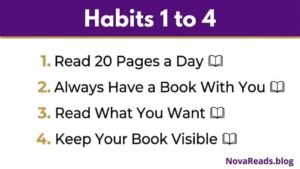
1. Read 20 Pages a Day
Twenty pages takes 20 to 30 minutes. At that pace, you finish roughly 15 books a year.
Most people underestimate how much 20 pages adds up to. They skip it on busy days because it feels small. But 20 pages every day beats 100 pages on weekends with nothing in between. Consistency compounds.
Set a daily page target low enough that missing it feels genuinely unusual. Twenty pages is that number for most readers.
What changes: You stop thinking of reading as something you do when you have time. You make it something that happens every day regardless of how much time you have.
2. Always Have a Book With You
The average person waits 45 to 60 minutes per day at appointments, in queues, between meetings. That is reading time being wasted on a phone.
Keep a book in your bag. Keep one on your phone as a backup. The moment you have 5 minutes with nothing structured, open it instead of a social media app.
You do not need long uninterrupted blocks to read more books. You need to fill the small gaps consistently.
3. Read What You Actually Want to Read
The fastest way to read less is to read books you feel obligated to finish but do not actually enjoy.
Reading is not homework. There is no prize for finishing a book you hate. A book you cannot put down will teach you more about reading consistently than a book you force yourself through.
Give a book 50 pages. If it has not earned your attention by then, move on. Readers who quit books they dislike read more books overall not fewer.
Choosing the right book also means
knowing how to analyze a book once
you start reading it.
4. Keep Your Book Visible
You will read what you see. You will ignore what is hidden.
A book left on the kitchen counter gets read. A book left in a drawer does not. Kindle apps on a phone buried in a folder do not get opened. A phone with the Kindle app on the home screen does.
Place your current book somewhere you look every day. The visual reminder removes the decision to start. You just pick it up.
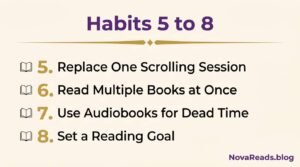
5. Replace One Scrolling Session Per Day
The average person spends 2 hours and 27 minutes per day on social media according to data from DataReportal 2026. Replacing 30 minutes of that with reading gives you enough time to finish 2 books per month.
You do not need to eliminate scrolling. You need to replace one session.
Pick the easiest one to swap. The first scroll of the morning. The last scroll before sleep. The scroll between tasks at work. Replace just that one with 20 to 30 minutes of reading. Everything else stays the same.
6. Read Multiple Books at Once
Reading one book at a time works for some readers. But for many, it creates a bottleneck. If the current book gets slow, reading stops entirely.
Reading 2 or 3 books at once removes that bottleneck. Keep one lighter read for evenings when your focus is low. Keep one challenging book for mornings when concentration is high. Keep one audiobook for commutes and chores.
You do not have to read all 3 simultaneously. But having options means you always have something you want to pick up.
Need help building your reading list?
Check our list of best books for
confidence to get started.
7. Use Audiobooks for Dead Time
Driving, cooking, cleaning, exercising these are hours that cannot be used for traditional reading. Audiobooks turn them into reading time.
An average audiobook runs 9 to 12 hours. If you commute 30 minutes each way 5 days a week, you finish roughly 2 audiobooks per month without changing anything else in your life.
8. Set a Reading Goal for the Year
People who set specific reading goals read more than people who say they want to read more without a number attached.
A goal of 12 books per year 1 per month is achievable for almost any reader. A goal of 24 books requires 20 minutes of daily reading. A goal of 52 books requires discipline but is realistic with audiobooks added.
Write your goal down. Put it somewhere visible. Check your progress monthly. The simple act of tracking creates accountability that vague intentions never do.
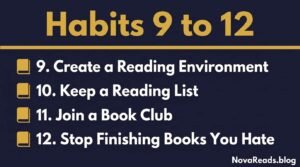
9. Create a Reading Environment
Reading is easier in some environments than others. A quiet room, good lighting, and a comfortable chair make reading feel natural. A noisy room with a phone nearby makes it feel like an effort.
You do not need a dedicated library. You need one spot in your home that is associated with reading. A specific chair. A corner of your bedroom. A spot on the couch where your book lives.
When you sit in that spot, your brain starts to expect reading. The habit builds through association over time.
10. Keep a Reading List
Readers who know what they are reading next start their next book immediately. Readers without a list stall for days or weeks between books looking for something to read.
Maintain a list of 5 to 10 books you genuinely want to read. Update it regularly. When you finish a book, your next one is already chosen.
The stall between books is where reading habits die. A reading list eliminates the stall.
11. Join a Book Club or Reading Challenge
Accountability accelerates everything. A book club gives you a deadline, a discussion to prepare for, and a social reason to finish.
If a formal book club does not fit your schedule, reading challenges work similarly. The 52 Book Club challenge, hosted annually, gives readers 52 prompts and a global community of participants. Completing a reading challenge publicly creates the same accountability a book club provides.
External structure works when internal motivation is inconsistent which is most of the time for most people.
12. Stop Finishing Books You Hate
This sounds counterintuitive. But readers who give themselves permission to quit bad books read significantly more books over time.
The obligation to finish every book you start creates a reading backlog of dread. You avoid picking up any book because the current one is a chore. Quitting that book removes the obstacle.
The rule: give every book 50 pages. If it has not earned your full attention by page 50, close it. Move on. Your reading list is too long to spend time on books that do not serve you.
How Many Books Can You Read in a Year?
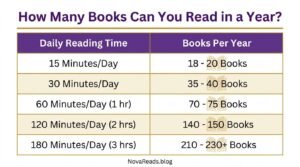
| Daily Reading Time | Books Per Year |
|---|---|
| 15 minutes | 8 to 10 books |
| 30 minutes | 15 to 18 books |
| 45 minutes | 25 to 30 books |
| 1 hour | 35 to 40 books |
| Audiobooks added | +12 to 24 books |
FAQ
How to read more books when you have no time?
Read 20 pages a day. That takes 20 to 30 minutes and finishes 15 books a year. Use audiobooks during commutes, cooking, and exercise. Replace one daily scrolling session with reading. You have more reading time than you think it is just currently being used for something else.
How many books should I read per month?
One book per month is a realistic starting point for most readers. That is 12 books per year with 20 to 30 minutes of daily reading. Once that becomes habitual, increase the target. Consistency over 12 months matters more than ambitious targets that fall apart by February.
Does listening to audiobooks count as reading?
Yes. Research on reading comprehension shows minimal difference in retention between reading and listening for most book types. Audiobooks are particularly effective for narrative non fiction and self help. Dense academic or technical content is generally better absorbed through reading.
What is the best time of day to read?
The time you will actually do it consistently. Morning reading works for people who are alert early. Evening reading works for people who need a way to wind down. The best time is personal but bedtime reading has one advantage: it replaces phone scrolling at the moment that habit is hardest to break.
Why do I start books but never finish them?
Usually because the book is not the right fit, the reading environment has too many distractions, or there is no clear next step after putting it down. Fix these three: choose books you genuinely want to read, create a dedicated reading spot, and always know what page you are returning to.
How long does it take to read a 300 page book?
At an average reading speed of 250 to 300 words per minute, a 300 page book takes 6 to 8 hours of reading time. At 30 minutes per day, that is 12 to 16 days. At 20 minutes per day, that is 18 to 24 days roughly one book every 3 weeks, or about 17 books per year.
What should I read if I want to read more but do not know where to start?
Start with a book in a genre you already enjoy consuming in another format. If you watch crime documentaries, read true crime. If you watch fantasy films, read fantasy novels. The easiest way to build a reading habit is to choose books that feel like entertainment, not obligation.
Is it better to read one book at a time or multiple?
Both approaches work. Reading one book at a time builds deeper focus and comprehension. Reading multiple books prevents stalling when one book gets slow. The better question is which approach keeps you reading consistently. Start with one book. Add a second only if you notice yourself stalling.
How do I stay focused while reading?
Remove your phone from the room or turn it face down. Read in a quiet environment. Start with a short commitment — 10 pages — to build momentum. If your mind wanders, reread the last paragraph instead of continuing. Focus in reading, like focus in anything else, improves with practice.
How do I remember what I read?
Write one sentence per chapter after you finish it. Review your notes before starting the next reading session. Discuss what you read with someone else within 24 hours of finishing. Teaching or explaining forces retrieval and retrieval is what moves information from short term to long term memory.