

Most book reviews are forgotten within 30 seconds of reading them. They say nothing specific, criticize nothing honestly, and leave the reader exactly where they started unsure whether to read the book or not.
The reviews people bookmark, share, and return to are different. They do something specific. They answer the one question every reader actually has: is this book worth my time?
Here are 10 qualities that separate a good book review from one nobody reads twice.
What Makes a Good Book Review?
A good book review gives the reader enough specific information to make a clear decision read this book or skip it. It is honest about weaknesses, specific about strengths, and written for the reader rather than the author.
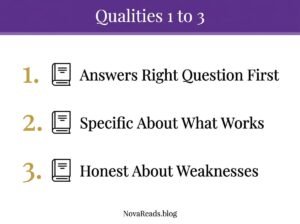
1. It Answers the Right Question First
The wrong question: Did I enjoy this book?
The right question: Should you read this book?
Those are different questions — and most reviewers answer the first while readers need the second. Your personal enjoyment matters only as evidence. What matters to the reader is whether the book solves their specific problem, matches their reading preferences, or delivers what the cover promises.
A good book review puts the reader’s question first. It answers that question within the first 2 paragraphs.
2. It Is Specific About What Works
“Beautifully written.” “Thought provoking.” “A must read.”
These phrases appear in thousands of reviews. They mean nothing because they apply to thousands of books. A reader cannot use them to make a decision.
Specific praise sounds different:
“Chapter 4 reframes procrastination as an emotional regulation problem rather than a time management one. That single idea made the rest of the book worth reading.”
“The author interviews 12 researchers across 6 countries and references their original papers. Every major claim is traceable.”
Specific praise gives the reader a reason to trust the reviewer. It also tells them exactly what they are getting into.
3. It Is Honest About What Does Not Work
A review without criticism is marketing.
Readers know this. They discount praise from reviewers who never criticize anything. But they trust reviewers who are fair and honest about a book’s limitations.
Honest criticism does not mean being harsh. It means being accurate.
“The second half repeats the first half’s arguments with different examples. If you grasp the core idea early, you can stop at chapter 6 without missing anything.”
“The author makes a strong case in theory but provides no practical framework for implementation. You finish the book knowing why, but not how.”
Those criticisms are useful. They prepare the reader for what they will actually experience and they build your credibility as a reviewer.
4. It Identifies Who the Book Is For
Every book serves a specific reader. A good review names that reader precisely.
Not: “This book is for anyone interested in personal growth.”
But: “This book is best for readers who already have basic habits in place and want to understand the psychology behind why habits form. Beginners may find it too theoretical.”
That 2 sentence description saves the wrong reader 8 hours. That is genuine value — and readers remember reviewers who deliver it.
5. It Names Who Should Skip the Book
This is the quality most reviewers skip. It is also the quality that builds the most trust.
Telling someone not to read a book takes confidence. It means you are more interested in being useful than in appearing positive. Readers notice that.
“If you have already read Atomic Habits by James Clear, this book covers similar territory without adding significant new ideas. Read it only if you want a different framing of the same concepts.”
That sentence is worth more to the right reader than 500 words of praise.
6. It Supports Claims With Specifics
Every strong claim in a book review needs specific support.
Weak: “The research in this book is impressive.”
Strong: “The author cites 34 peer reviewed studies, including a 2022 Stanford University study on habit formation that tracked 1,200 participants over 18 months.”
Weak: “The writing drags in the middle.”
Strong: “Chapters 7 through 10 cover the same central argument with different examples. The book could lose 60 pages without losing any substance.”
Specifics are the difference between a review that informs and a review that fills space.
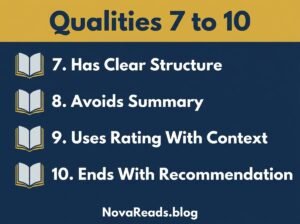
7. It Has a Clear Structure
A good book review is easy to scan. Readers often skim before they commit to reading in full. If your structure is clear, skimmers still get the key information.
A simple structure that works for any book review:
- Opening hook most interesting thing about the book
- What the book is trying to do
- What works 2 to 3 specific strengths
- What does not work 1 to 2 honest criticisms
- Who should read it
- Who should skip it
- Final verdict in 1 sentence
That structure takes 5 minutes to fill in. It produces a review readers can use in under 3 minutes.
8. It Avoids Summary Disguised as Review
Summarizing a book is not reviewing it. Readers can read the back cover for a summary. They come to a review for assessment.
The test is simple. Ask yourself after each paragraph: am I summarizing what happened or am I evaluating whether it worked?
If you are summarizing, cut it or turn it into evidence for a specific claim.
“In chapter 3, the author explains the concept of identity based habits” this is summary.
“The identity based habit framework in chapter 3 is the most original idea in the book it explains why willpower fails in a way that purely behavioral approaches miss” this is review.
9. It Uses a Rating With Context
Star ratings are useful shortcuts. But a rating without context is almost meaningless.
4 stars from a reader who reads 100 books a year means something different from 4 stars from a first time reader of the genre. Both are valid. Neither is useful without context.
Always explain your rating in 1 sentence:
“4 out of 5 exceptional for readers new to behavioral science, repetitive for those who have read Thinking, Fast and Slow by Daniel Kahneman.”
That sentence does more work than the rating itself.
10. It Ends With a Clear Recommendation
The last thing a reader sees should be a direct answer.
Not: “Overall, this is an interesting book that raises many important questions and will appeal to a wide variety of readers.”
But: “Read this if you want a practical framework for building better habits. Skip it if you have already read Atomic Habits — the territory overlaps significantly.”
A clear ending respects the reader’s time. It tells them exactly what to do with the information they just read.
The Difference Between a Forgettable Review and a Useful One
| Forgettable Review | Useful Review |
|---|---|
| Vague praise | Specific examples |
| No criticism | Honest limitations |
| Summary of plot | Assessment of value |
| Written for the author | Written for the reader |
| No recommendation | Clear verdict |
| Any reader | Specific reader profile |
FAQ
How long should a good book review be?
Between 400 and 800 words for a blog post. Long enough to cover the key qualities — specificity, honesty, structure, and recommendation. Short enough that a reader finishes it before deciding whether to buy the book.
Should a good book review always include criticism?
Yes. A review with no criticism is not a review — it is a testimonial. Readers trust reviewers who are honest about weaknesses. That honesty is what makes the praise meaningful when it appears.