
Introduction
Reading a self help book does not change your life by itself. Applying one idea from it does.
That difference matters. Most people treat self help books like entertainment they read, highlight, feel inspired for 3 days, then return to old patterns. But readers who treat these books as instruction manuals see real results.
Here are 10 proven benefits of reading self help books and exactly how each one works.
What Are the Benefits of Reading Self Help Books?
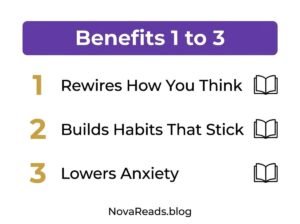
The biggest benefits of reading self help books include better mindset, stronger habits, lower anxiety, and clearer goals. Research published by the American Psychological Association confirms that bibliotherapy using books for psychological growth works as well as some forms of therapy for mild to moderate challenges.
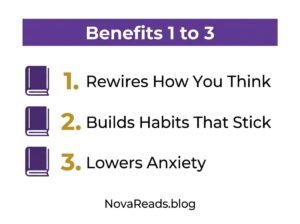
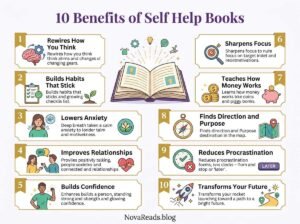
1. Self Help Books Rewire How You Think
Most people walk around with thought patterns they picked up before age 10. Self help books expose those patterns and give you tools to change them.
Carol Dweck’s research at Stanford University showed that students who learned about growth mindset improved their grades within one semester. The concept: your abilities are not fixed. They grow with effort.
Books like Mindset by Carol Dweck and Thinking, Fast and Slow by Daniel Kahneman show you exactly how your brain makes decisions and where it goes wrong. Once you see the pattern, you can interrupt it.
What changes: You stop saying “I’m just not good at this” and start asking “What would it take to get better at this?”
2. They Build Habits That Stick
Motivation fades. Systems stay.
That is the core argument of Atomic Habits by James Clear and it is backed by behavioral science. Clear explains that every action you take is a vote for the type of person you believe you are. Small habits compound over time into identity change.
For example, someone who reads 10 pages a day finishes 12 books a year. Someone who exercises for 20 minutes daily builds a body that looks and feels different in 6 months. Neither of those requires willpower. They require a system.
Self help books give you the system. They break behavior change into steps small enough to actually follow.
What changes: You stop relying on motivation and start building habits that run on autopilot.
3. Self Help Books Lower Anxiety
Anxiety often comes from uncertainty. Self help books reduce uncertainty by giving you frameworks for situations that used to feel overwhelming.
Chatter by Ethan Kross based on his research at the University of Michigan explains that the inner voice becomes toxic when it loops without purpose. His solution: psychological distancing. Refer to yourself by name when processing a difficult situation. That simple technique creates mental space between you and the anxiety.
Other books like The Worry Trick by David Carbonell use Cognitive Behavioral Therapy techniques to show how fighting anxiety makes it stronger and how accepting it actually reduces it.
What changes: You stop catastrophizing and start processing difficult emotions with specific tools instead of spinning in place.
4. They Improve Your Relationships
Many relationship problems come from communication gaps, not personality clashes.
Nonviolent Communication by Marshall Rosenberg gives a 4-step framework: observations, feelings, needs, requests. It teaches people to say what they mean without triggering defensiveness. Couples who practice this method report fewer arguments and faster resolution.
Attached by Amir Levine explains attachment theory in plain language. Understanding your attachment style — anxious, avoidant, or secure explains why you react the way you do in close relationships.
What changes: You stop reacting and start responding. The difference in your relationships is noticeable within weeks.
5. Self Help Books Build Real Confidence
Confidence is not a personality trait. It is a skill and self help books teach it step by step.
The Charisma Myth by Olivia Fox Cabane breaks down social confidence into learnable components: presence, warmth, and power. Each one has a specific exercise. Readers who try her pre-meeting warmth exercise report speaking up more in the following 3 interactions.
Feel the Fear and Do It Anyway by Susan Jeffers makes a key argument: fear never fully disappears. Confidence is not waiting for fear to go away it is acting alongside it.
What changes: You stop waiting until you feel ready. You act first and build confidence as a result of action, not before it.
6. They Sharpen Your Focus and Productivity
The average person checks their phone 96 times per day according to research by Asurion. That is once every 10 minutes.
Deep Work by Cal Newport explains why that matters: the ability to focus without distraction is becoming rare and valuable at the same time. People who master deep focus produce better work in less time.
Essentialism by Greg McKeown adds another layer. Most people fill their schedule with things that feel urgent but are not important. McKeown’s framework helps you identify the 20% of efforts that produce 80% of results — and eliminate the rest.
What changes: You stop being busy and start being productive. The output quality difference is visible within 30 days.
7. Self Help Books Teach You How Money Works

Most schools do not teach personal finance. Self help books fill that gap.
The Psychology of Money by Morgan Housel explains that financial success has less to do with intelligence and more to do with behavior. Specifically: how you handle money during emotional moments.
Rich Dad Poor Dad by Robert Kiyosaki challenges the conventional idea that working harder leads to wealth. His core lesson: understand how money works before you try to earn more of it.
I Will Teach You to Be Rich by Ramit Sethi gives a 6-week action plan for automating savings and investments. The system requires about 2 hours to set up. After that, it runs without decision-making.
What changes: You stop avoiding financial decisions and start making them with a clear framework.
8. They Help You Find Direction and Purpose
Many people feel busy but purposeless. They know what they are doing but not why.
Man’s Search for Meaning by Viktor Frankl — written after his experience in Nazi concentration camps — argues that humans can survive almost any situation if they have a strong enough reason. Purpose is not found. It is built through commitment to something meaningful.
Start With Why by Simon Sinek applies that principle to work and leadership. People who know their why outperform people who only know their what or how.
What changes: You stop drifting and start making decisions that align with what you actually value.
9. Self Help Books Reduce Procrastination
Procrastination is not a time management problem. It is an emotional regulation problem.
Research from Carleton University found that people procrastinate to avoid negative emotions fear, boredom, self-doubt not because they are lazy. Self help books address the emotional root, not just the behavior.
The Now Habit by Neil Fiore gives a guilt-free scheduling method that reduces procrastination by removing the pressure that causes avoidance in the first place. Eat That Frog by Brian Tracy uses a simple principle: do the hardest task first. Everything after feels easier by comparison.
What changes: You stop waiting for the right mood to start. You start before you feel ready — and discover that starting is the hard part, not the work itself.
10. They Give You a Community of Ideas
Reading self help books connects you to a community of thinkers even when you are reading alone.
When you finish Atomic Habits, you can discuss it with anyone else who has read it. You share a framework and a vocabulary. That shared language makes conversations about growth faster and more specific.
Online communities around books like The Mountain Is You by Brianna Wiest have hundreds of thousands of members discussing the ideas and applying them together. Pinterest boards dedicated to self help books attract millions of monthly views because readers want to share what moved them.
Books create belonging. That is not a small thing.
What changes: You stop feeling alone in your growth. You find people who are working on the same things you are.
How to Get the Most From Self Help Books
Reading is the easy part. Application is where most people stop.
Three rules that actually work:
Read one book at a time. Jumping between books spreads your attention too thin. Finish what you start.
Apply one idea before moving on. Pick the single most useful idea from each chapter. Try it for 7 days before reading further.
Write down one sentence per chapter. Not a summary a commitment. “I will do X this week.” That sentence is worth more than 10 highlighted passages.
Which Self Help Book Should You Start With?
| Your Goal | Best Book |
|---|---|
| Build better habits | Atomic Habits |
| Lower anxiety | Chatter |
| Find purpose | Man’s Search for Meaning |
| Improve relationships | Nonviolent Communication |
| Build confidence | The Charisma Myth |
| Manage money | The Psychology of Money |
| Improve focus | Deep Work |
| Stop procrastinating | The Now Habit |
FAQ
Do self help books actually work?
Yes but only when you apply the ideas, not just read them. Research from the American Psychological Association shows bibliotherapy works as well as some forms of therapy for mild to moderate challenges when readers actively engage with the material.
How many self help books should I read per year?
Quality beats quantity. Reading 4 to 6 books per year deeply with application and reflection produces more change than reading 30 books without implementing anything.