

Introduction
Finishing a book is easy. Understanding what it actually says is harder.
Most readers finish a book, feel something, and move on. But that feeling fades within days. Book analysis changes that. It gives you tools to understand what the author is doing, why certain choices work, and what the book actually means beyond its surface story.
Here is a complete step by step guide on how to analyze a book properly.
What Does It Mean to Analyze a Book?
To analyze a book means to examine it critically looking beyond the story to understand its themes, structure, characters, writing style, and deeper meaning. Book analysis is not just for students or academics. It is for any reader who wants to get more out of what they rea
Step 1: Understand the Author’s Purpos
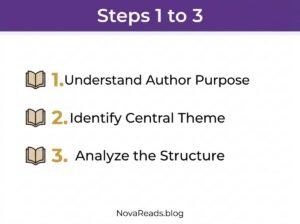
Every book is written for a reason. The first step in analyzing a book is asking: what is this author trying to do?
Authors write books to inform, persuade, entertain, challenge assumptions, or process their own experiences. Understanding the purpose changes how you read everything else.
Ask yourself 3 questions before analyzing anything else:
Why did this author write this book?
Who is the intended reader?
What does the author want the reader to think, feel, or do after finishing?
A self help book trying to change behavior reads differently from a memoir trying to make sense of grief. Identifying the purpose first gives your entire analysis a clear direction.
Step 2: Identify the Central Them
The theme is the central idea the book keeps returning to. It is not the plot. It is the deeper truth the plot is built around.
Finding the theme requires looking for patterns. What questions does the book keep raising? What tensions never fully resolve? What idea appears in multiple scenes, characters, or arguments?
Common themes in self help books:
- The gap between knowing and doing
- Identity change as the foundation of behavior change
- Fear as a signal rather than a stop sign
Common themes in fiction:
- The cost of ambition
- The tension between loyalty and self interest
- What we sacrifice for belonging
Write your theme in 1 sentence. If you cannot, read the book again with this question in mind: what is this book really about?
Step 3: Analyze the Structure
Structure is how the author organizes the book. It is not accidental. Every structural choice shapes how the reader experiences the content.
For non fiction books, ask:
- Does the author build an argument chapter by chapter, or does each chapter stand alone?
- Are the strongest ideas at the beginning, middle, or end?
- Does the structure match the content? A book about systems should itself feel systematic.
For fiction books, ask:
- What is the story structure? Does it follow a traditional arc?
- Where does the tension peak?
- What does the ending resolve, and what does it leave open?
Structure reveals what the author values most. The chapters they spend the most time on are the ideas they consider most important.
Step 4: Examine the Characters or Voices
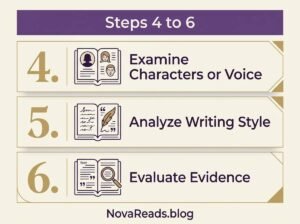
In fiction, characters carry the themes. In non fiction, the author’s voice is itself a character.
For fiction:
Look at how characters change from beginning to end. A character who ends the book exactly where they started is either a symbol of stagnation or a commentary on the limits of change. Neither is accidental.
Ask:
- What does the main character want at the start?
- What do they actually need?
- What prevents them from getting it?
- How do they change, or fail to change?
For non fiction:
The author’s voice confident, uncertain, authoritative, conversational shapes how you receive the information. A humble voice invites questioning. An authoritative voice demands acceptance. Neither is better. But both are deliberate choices worth noticing.
Step 5: Analyze the Writing Style
Writing style is how the author uses language. It includes sentence length, word choice, tone, and rhythm.
Short sentences create urgency. Long sentences slow the reader down and create complexity. Most skilled authors use both deliberately.
Questions to ask about writing style:
- Does the author use simple language or complex vocabulary?
- Are the sentences short and punchy, or long and layered?
- Is the tone warm, clinical, ironic, or urgent?
- Does the style match the subject? A book about slowing down should not feel rushed.
Style analysis reveals craft. It shows you what the author is doing consciously and gives you a standard to compare other books against.
Step 6: Evaluate the Evidence and Arguments
This step applies primarily to non fiction, but also to fiction that makes claims about how the world works.
For every major claim in the book, ask:
- What evidence does the author provide?
- Is that evidence specific and traceable, or vague and anecdotal?
- Does the evidence actually support the claim, or is the author stretching it?
- Are there counterarguments the author ignores or dismisses too quickly?
A book that makes strong claims without strong evidence should be read with skepticism even if the claims feel intuitively right. Intuition is not evidence.
This step is where honest book analysis separates itself from enthusiastic agreement. The books that hold up to
Step 7: Identify What the Book Gets Wrong
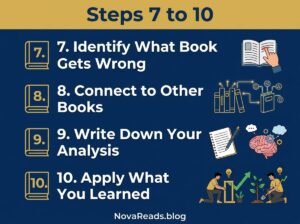
No book is perfect. An honest analysis includes what the author misses, oversimplifies, or gets flat wrong.
This is not about finding reasons to dismiss the book. It is about reading with your critical thinking switched on.
Common weaknesses to look for:
- Overgeneralizations presented as universal truths
- Research cited without naming the source
- Counterarguments ignored rather than addressed
- Claims that sound reasonable but do not hold up under pressure
- Advice that works in theory but ignores practical constraints
Finding weaknesses does not make a book bad. It makes your understanding of it more accurate and more useful.
Step 8: Connect the Book to Other Books and Ideas
No book exists in isolation. Every author is in conversation with other thinkers, whether they name them or not.
Ask:
- What other books does this remind you of?
- Does this book agree, disagree, or build on something you have read before?
- Where does this author’s argument fit in a larger conversation?
Connecting books to each other deepens your understanding of both. Atomic Habits by James Clear makes more sense after reading The Power of Habit by Charles Duhigg. Daring Greatly by Brene Brown means something different after reading The Gifts of Imperfection by the same author.
Reading is not a series of isolated experiences. It is a long conversation. Book analysis helps you participate in it.
Step 9: Write Down Your Analysis
Reading your analysis is useful. Writing it is transformative.
Writing forces clarity. You cannot write vaguely about a theme and feel that you understand it. You have to commit to a specific claim — and that commitment reveals whether your understanding is solid or just impressionistic.
Step 10: Apply What You Learned
The final step in book analysis is the most practical one. What do you actually do with what you found?
Analysis without application is an academic exercise. The goal is not just to understand the book more deeply it is to use that understanding.
For non fiction: Pick 1 idea from your analysis and apply it this week. Not the whole book. One idea.
For fiction: Identify 1 truth the book revealed about human nature. Write it down. See where you notice it in real life over the next 30 days.
Books analyzed carefully stay with you far longer than books consumed quickly. That is the real reason to learn how to analyze a book.
Book Analysis Quick Reference
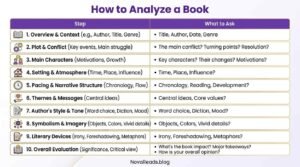
| Step | What to Ask |
|---|---|
| 1. Author’s Purpose | Why did they write this? |
| 2. Central Theme | What is it really about? |
| 3. Structure | How is it organized? |
| 4. Characters or Voice | Who changes and how? |
| 5. Writing Style | How does language work here? |
| 6. Evidence | Do claims hold up? |
| 7. Weaknesses | What does it get wrong? |
| 8. Connections | How does it fit with other books? |
| 9. Write It Down | What is your actual conclusion? |
| 10. Apply It | What will you do differently? |
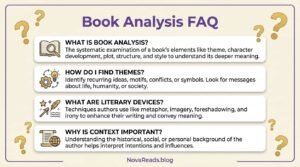
1. How to analyze a book step by step?
Start by identifying the author’s purpose, then find the central theme, examine the structure, analyze characters or voice, evaluate the writing style, check the evidence, identify weaknesses, connect it to other books, write your analysis, and apply what you learned. These 10 steps work for any book.
2. How long does it take to analyze a book?
A basic analysis takes 20 to 30 minutes after finishing a book if you read with notes. A thorough analysis covering all 10 steps takes 60 to 90 minutes. The investment pays back in retention and understanding that lasts years instead of days.
3. Do you need to be an expert to analyze a book?
No. Book analysis is a skill that improves with practice. The only requirement is reading the book carefully and asking the right questions. Every reader who finishes a book already has an opinion. Analysis just gives that opinion structure and evidence.
4. What is the difference between reading and analyzing a book?
Reading is absorbing the content. Analyzing is questioning it. A reader finishes and moves on. An analyzer finishes and asks why the author made specific choices, what the theme actually is, and whether the arguments hold up under pressure.
5. How do you find the theme of a book?
Look for patterns. What questions does the book keep raising? What tensions never fully resolve? What idea appears across multiple chapters, characters, or arguments? Write your theme in 1 sentence. If you cannot, you need to read the book again with this question in mind.
6. How do you analyze a non fiction book?
Focus on the author’s argument. Identify the central claim, examine the evidence for each major point, look for counterarguments the author ignores, and assess whether the structure supports or undermines the argument. Non fiction analysis is about evaluating whether the book earns its conclusions.
7. How do you analyze a fiction book?
Focus on character, theme, and structure. Ask what the main character wants versus what they need, how the structure creates tension, what the ending resolves and what it leaves open, and what truth about human nature the story reveals. Fiction analysis is about understanding what the story is really saying beneath the plot.
8. Should you take notes while reading to analyze a book?
Yes. Read with a pen. Mark passages that surprise you, confuse you, or stick with you. Write a 1 sentence reaction at the end of each chapter. These notes become the raw material of your analysis. Without them, you write from memory and memory smooths out the rough edges that make analysis useful.
9. How do you analyze the writing style of a book?
Look at sentence length, word choice, tone, and rhythm. Ask whether the style matches the subject. A book about slowing down should not feel rushed. A book about clarity should not use unnecessarily complex language. Style analysis reveals what the author is doing consciously and gives you a standard to compare other books against.
10. How do you know if a book is worth analyzing?
Any book you finish is worth at least a basic analysis. But books that stay with you, confuse you, or challenge your assumptions deserve deeper examination. The books that are hardest to summarize in 1 sentence are often the ones with the most to offer on closer inspection.