

Introduction
Motivation is unreliable. Everyone knows this. Yet most people keep waiting for it.
Self discipline is not about wanting it badly enough. It is not about willpower. It is about building systems so good that discipline becomes the default not the daily battle.
These 12 books teach that shift. Each one targets a different piece of the problem: habits, focus, mental toughness, environment design, and identity. Pick the one that matches where
Understanding self help books benefits will show you exactly why self discipline books produce results that last.
What Are the Best Books for Self Discipline?
The best books for self discipline give you specific systems and frameworks not just motivation. They show you how consistent behavior is built through design, environment, and identity rather than raw willpower.
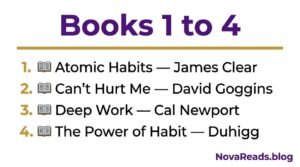
1. Atomic Habits by James Clear
Best for: Building discipline through small systems
This is the most recommended self discipline book for a reason. Clear’s central argument: you do not rise to the level of your goals. You fall to the level of your systems.
Every habit is a vote for the type of person you believe you are. Change your identity first “I am someone who reads” rather than “I want to read more” and behavior follows naturally. The 4 laws of behavior change give you a practical framework to apply immediately.
At an average reading speed, most readers finish this book in 4 to 5 hours. The ideas stay for years.
Who should read it: Anyone who has tried and failed to build discipline through motivation alone.
Self discipline and emotional intelligence
work together read our guide on best
books for emotional intelligence to see why.
2. Can’t HSelf discipline and emotional intelligence
Best for: Mental toughness and extreme discipline
Goggins was overweight, working as a pest exterminator, and failing. He became a Navy SEAL, Army Ranger, and one of the most decorated endurance athletes alive.
His argument is uncomfortable: most people operate at 40% of their actual capacity. The other 60% is locked behind discomfort they are not willing to face. This book is about unlocking that other 60% — not through inspiration but through deliberate exposure to difficulty.
This is not a gentle book. But for readers who feel they have been coasting, nothing cuts through the noise faster.
Who should read it: People who know what to do but keep finding reasons not to do it.
3. Deep Work by Cal Newport
Best for: Focus and cognitive discipline
Newport makes a claim worth sitting with: the ability to focus without distraction is becoming rare and enormously valuable at the same time. Most people are losing this ability. The few who develop it will dominate.
Deep work is defined as professional activity performed in a state of distraction-free concentration that pushes cognitive capabilities to their limits. Newport gives 4 rules for cultivating it and specific scheduling strategies for different lifestyles.
Who should read it: Anyone whose primary discipline problem is focus rather than habits people who sit down to work and immediately check their phone.
4. The Power of Habit by Charles Duhigg
Best for: Understanding how habits actually work
Before you can build discipline, you need to understand the mechanism behind it. Duhigg’s habit loop cue, routine, reward explains why habits form, why they are so hard to break, and exactly how to change them.
The most useful idea in this book: you cannot eliminate a bad habit. You can only replace the routine while keeping the same cue and reward. That single insight changes how you approach every discipline problem.
Who should read it: People who understand they have bad habits but keep failing to change them despite genuine effort.
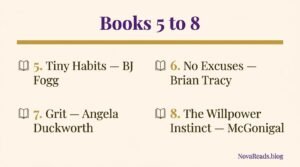
5. Tiny Habits by BJ Fogg
Best for: Starting discipline when everything else has failed
Fogg’s research at Stanford University identified why most discipline efforts fail: the behaviors are too big and the motivation required to sustain them runs out. His solution is to shrink the behavior until it requires no motivation at all.
Floss one tooth. Do 2 push-ups. Read one sentence. These are not metaphors for ambition. They are the actual starting point. The research shows behaviors anchored to existing routines and celebrated immediately after create lasting change at a rate most other methods cannot match.
Who should read it: Perfectionists who set ambitious discipline goals, fail after 2 weeks, and conclude they are simply not disciplined people.
6. No Excuses by Brian Tracy
Best for: Discipline across every area of life
Tracy’s argument is direct: self discipline is the single most important quality for success in life. Not talent. Not intelligence. Not luck. Discipline.
The book covers 21 areas where discipline determines outcomes from personal goals to financial success to relationships. Each chapter gives specific practices. There is no theory without application.
It is older than most books on this list. But the ideas are not dated. Discipline has not changed.
Who should read it: People who want a comprehensive, no-nonsense framework for discipline across all areas of life rather than focus on one specific habit.
7. Grit by Angela Duckworth
Best for: Long-term consistency and perseverance
Duckworth spent years studying high performers across fields West Point cadets, National Spelling Bee champions, sales professionals. Her finding: talent predicts early performance. Grit passion combined with perseverance predicts long-term success.
The most important insight for discipline: grit is not the same as stubbornness. It is the ability to maintain effort and interest over years despite failure, plateaus, and adversity. That is a skill. And it can be developed.
Who should read it: People who start strong but give up when progress slows readers who mistake the dip for failure rather than for normal.
8. The Willpower Instinct by Kelly McGonigal
Best for: Understanding why willpower fails
McGonigal taught a Stanford University course on the science of self control. This book is that course in written form.
Her most useful finding: willpower is a physiological resource, not a character trait. It depletes throughout the day. This explains why discipline fails at night, after long decision-heavy days, and under chronic stress. Once you understand this, you can design your day to protect it.
Who should read it: People who are disciplined in the morning and completely undisciplined by evening readers who make commitments at 7 AM and break them by 9 PM.
According to the American Psychological
Association, willpower depletion is a
well documented phenomenon that affects
decision making and self control throughout
the day.
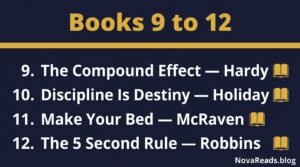
9. The Compound Effect by Darren Hardy
Best for: Understanding how small disciplines multiply
Hardy’s central idea: small choices compounded over time produce radical results in either direction. A 1% daily improvement becomes a 37-times improvement over a year. A 1% daily decline produces near zero.
The book is about making the connection between today’s small discipline and next year’s outcome a connection most people fail to make because the feedback loop is too slow to feel.
Who should read it: People who dismiss small daily disciplines because the results are not immediately visible.
10. Discipline Is Destiny by Ryan Holiday
Best for: Philosophy of self discipline
Holiday draws on Stoic philosophy Marcus Aurelius, Epictetus, Seneca to argue that self-mastery is not a means to an end. It is the end itself. The person you become through discipline is the reward, not just the outcomes discipline produces.
This book will not give you a habit tracker or a morning routine. It will give you a reason to want discipline that outlasts any motivational spike.
Who should read it: People who have tried every system but lack a deeper reason to stay disciplined when systems fail.
11. Make Your Bed by William H. McRaven
Best for: Starting discipline with the smallest possible action
McRaven delivered a University of Texas commencement address in 2014. It went viral. This book expands on the 10 lessons from that speech.
The first lesson: make your bed every morning. Not because a made bed matters. Because completing a small task first thing creates a chain reaction of accomplishment. Discipline starts with one small win. Then another.
At under 200 pages, this is the shortest book on this list. Read it in one sitting. Then make your bed tomorrow.
Who should read it: Anyone who feels overwhelmed by where to start readers who need one concrete, undeniable first step.
12. The 5 Second Rule by Mel Robbins
Best for: Beating hesitation and starting immediately
Robbins discovered this rule by accident. She counted down from 5 to 1 before getting out of bed one morning when she did not want to. It worked. She started using it everywhere.
The science behind it: the prefrontal cortex the decision-making part of the brain can be activated by counting backward. It interrupts the habit of hesitation and forces physical action before the brain talks you out of it.
It sounds too simple. The research on implementation intentions suggests it is not.
Who should read it: People who know what they should do and still do not do it readers for whom hesitation is the primary discipline problem.
Which Book Should You Start With?
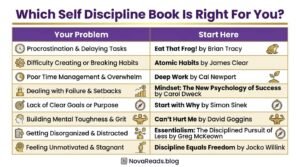
| Your Problem | Start Here |
|---|---|
| No system at all | Atomic Habits |
| Too comfortable | Can’t Hurt Me |
| Cannot focus | Deep Work |
| Bad habits you cannot break | The Power of Habit |
| Failed every big plan | Tiny Habits |
| Willpower runs out by evening | The Willpower Instinct |
| Need a deeper reason | Discipline Is Destiny |
| Do not know where to start | Make Your Bed |
FAQ
What is the best book for self discipline?
Atomic Habits by James Clear is the best starting point for most people. It treats discipline as a design problem rather than a character trait. Build small systems, shape your environment, and let the right behavior become automatic. The 4 laws of behavior change are immediately applicable and backed by behavioral science.
Can books actually improve self discipline?
Yes — but only through application. Reading about discipline without changing one behavior is itself an act of undiscipline. Pick one idea from whichever book you read and apply it for 30 days before moving on. One applied idea beats 10 read and forgotten ones.
What is the difference between motivation and self discipline?
Motivation is the feeling that makes starting easy. Self discipline is what keeps you going after that feeling fades — which it always does. The best books for self discipline focus on building systems that do not require motivation to sustain. Motivation starts the engine. Discipline keeps it running.
How long does it take to build self discipline?
Research on habit formation shows meaningful behavior change takes 21 to 66 days depending on the complexity of the behavior. Building discipline as a general trait — rather than one specific habit takes longer. Most readers of the books on this list report noticeable changes within 30 days if they apply one idea consistently.
What is the 40% rule from Can’t Hurt Me?
David Goggins argues that when your mind tells you it is done, you have only used about 40% of your actual capacity. The remaining 60% is locked behind discomfort you are unwilling to face. The rule is not about ignoring real physical limits it is about recognizing that most mental limits are not real limits at all.
Is self discipline genetic or learned?
Largely learned. Research by Angela Duckworth and others shows that while temperament has a genetic component, the behaviors that make up self discipline — consistent effort, delayed gratification, focus are developable skills. The brain’s plasticity means discipline can be built at any age through deliberate practice.
What is the habit loop from The Power of Habit?
Charles Duhigg’s habit loop has 3 components: cue, routine, and reward. The cue triggers the behavior. The routine is the behavior itself. The reward reinforces it. To change a habit, keep the cue and reward the same but replace the routine. This structure explains why cold turkey approaches so often fail.
Why does willpower fail at night?
Kelly McGonigal’s research shows willpower is a physiological resource that depletes throughout the day a phenomenon called ego depletion. Long days with many decisions drain this resource. The fix is to schedule your highest-discipline tasks early, when willpower is highest, and reduce decision load later in the day.
What is the compound effect in self discipline?
Darren Hardy’s compound effect shows that small consistent disciplines exercising 20 minutes daily, reading 10 pages, saving 5% of income — seem insignificant day to day but produce dramatic results over months and years. The challenge is that the feedback loop is too slow for most people to feel. Books like Atomic Habits help bridge that gap.
Which self discipline book is best for students?
Atomic Habits and Deep Work are the most directly applicable for students. Atomic Habits helps with consistent study habits. Deep Work addresses the focus required for demanding academic work. Together they cover the two most common discipline failures in academic settings: inconsistency and distraction.