

Introduction
That is not a memory problem. That is a reading method problem.
Most people struggle with how to remember what you read because they read passively words go in, a vague impression comes out. The readers who actually remember what they read do something different at every stage: before, during, and after reading.
These 10 techniques show you exactly how to remember what you read and retain information for years, not days. Apply even 3 of them consistently and your retention changes permanently.
Learning how to remember what you read
starts with reading consistently our
guide on how to read more books shows
you exactly how.
What Is the Best Way to Remember What You Read?
The best way to remember what you read is to engage actively with the material writing notes, making connections to things you already know, and retrieving the information shortly after reading. Passive reading produces passive retention. Active reading produces memory that lasts.
Technique 1: Read With a Pen in Your Hand
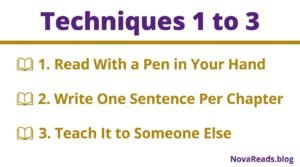
Highlighting is passive. Writing is active.
The difference matters because of how memory works. Reading something triggers recognition. Writing it in your own words triggers encoding the process that moves information from short-term to long-term memory.
Do not copy sentences. Write reactions. “This contradicts what I thought about X.” “This explains why Y kept failing.” “Apply this to Z.” Those 3 to 10 word notes are more valuable than any highlighted passage.
What changes: You stop being a reader of someone else’s ideas and start being a thinker in conversation with them. That shift alone doubles retention for most people.
Technique 2: Write One Sentence Per Chapter
Before moving to the next chapter, write one sentence that captures the most important idea from the chapter you just finished.
Not a summary. Not a list. One sentence. The constraint forces you to decide what actually mattered which is itself an act of processing that builds memory.
After finishing a book, you have a 12 to 20 sentence document that captures the entire argument. Review it once a week for a month. The book stays with you for years.
What changes: You stop reading chapters as events and start reading them as arguments worth capturing.
Technique 3: Teach It to Someone Else
The best test of whether you understood something is whether you can explain it clearly to someone who has not read it.
Teaching forces retrieval pulling information out of memory rather than putting it in. Research from Washington University shows retrieval practice produces significantly stronger long-term retention than rereading the same material.
You do not need an actual student. Explain the book’s main idea to a friend, write about it in a journal, or record yourself talking through it. The act of articulating produces the memory.
Teaching connects directly to analysis
read our guide on how to analyze a
book to see how these two skills work
together.
What changes: You discover exactly which parts you understood and which parts you only thought you understood a distinction that disappears when you read passively.
Technique 4: Connect New Ideas to Things You Already Know
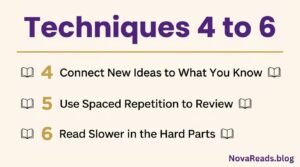
Memory is associative. New information sticks when it connects to something already stored.
When you encounter an idea in a book, pause and ask: where have I seen this before? What does this remind me of? How does this change something I already believed?
Atomic Habits by James Clear makes more sense after reading The Power of Habit by Charles Duhigg. Emotional Intelligence by Daniel Goleman means something different after reading Mindsight by Daniel Siegel. The connection between books is where the deepest learning happens.
What changes: You stop reading books in isolation and start building a connected network of ideas that reinforce each other.
Technique 5: Use Spaced Repetition to Review
Reading something once is almost never enough. The forgetting curve identified by psychologist Hermann Ebbinghaus shows that most people forget 70% of new information within 24 hours without review.
Spaced repetition solves this by reviewing information at increasing intervals: 1 day after reading, then 3 days, then 7 days, then 30 days. Each review strengthens the memory trace and extends the time before the next review is needed.
Your chapter sentences from Technique 2 are perfect material for spaced repetition. Review them at those intervals and the information moves from short-term to permanent memory.
According to the American Psychological
Association, spaced repetition is one
of the most evidence based methods for
long term memory retention.
What changes: You stop losing information after 2 weeks and start building a library of retained knowledge that compounds over time.
Technique 6: Read Slower in the Hard Parts
Most people read at the same pace throughout a book. That is a mistake.
Dense arguments, counterintuitive claims, and complex frameworks deserve slower reading. Not because slow reading is inherently better it is not but because these sections require processing time that fast reading does not allow.
When you feel resistance while reading — when a sentence requires rereading or an idea does not immediately make sense that is the signal to slow down, not speed up. Resistance is the feeling of your brain working. Do not avoid it.
What changes: You stop treating difficult sections as obstacles and start treating them as the most valuable parts of the book.
Technique 7: Summarize Each Book in 3 Sentences
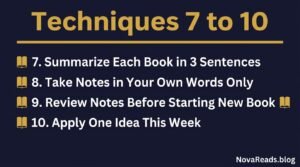
After finishing a book, write a 3 sentence summary before putting it down.
Sentence 1: What the book is trying to do.
Sentence 2: The most important idea in the book.
Sentence 3: What you will do differently because of it.
That third sentence is the one most people skip. It is also the one that matters most. Knowledge without application fades. Knowledge connected to a specific behavior change stays.
What changes: Every book becomes a commitment rather than just an experience. That commitment creates the retrieval cue that keeps the memory alive.
Technique 8: Take Notes in Your Own Words Only
Do not copy the author’s sentences into your notes. Rewrite every idea in your own language.
This sounds inefficient. It is actually faster at producing retention. When you copy a sentence, your brain treats it as a transcription task low cognitive engagement, low memory encoding. When you rewrite it in your own words, your brain treats it as a comprehension task high engagement, high encoding.
A note that says “Clear argues habits work through identity change you need to become the person first” encodes better than copying the original sentence even if the original sentence is better written.
What changes: Your notes become evidence of thinking rather than evidence of reading. The difference in what you retain is significant.
Technique 9: Review Your Notes Before Starting a New Book
Most people finish a book and immediately start the next one. That transition destroys retention of the first book.
Before starting a new book, spend 10 minutes reviewing your notes from the previous one. This review serves two purposes: it reinforces the memory of the first book at exactly the right moment — before it fades — and it creates a mental context that helps you connect ideas across books.
What changes: You stop treating each book as a self-contained experience and start building a reading practice where books talk to each other.
Technique 10: Apply One Idea This Week
The most reliable way to remember an idea is to use it.
Application creates the strongest memory trace of any technique on this list. When you apply an idea from a book and it works or fails in an interesting way the experience connects to the idea in memory through emotion, context, and consequence. That connection is almost impossible to forget.
Pick one idea from every book you finish. Not a vague intention a specific action. “I will use the 5 Second Rule tomorrow morning when my alarm goes off.” “I will write my chapter notes for the next 3 chapters before I stop reading today.”
One applied idea beats 10 read and forgotten ones.
What changes: Books stop being entertainment and start being tools. That shift transforms how you read, what you choose to read, and how much you retain.
How Long Does It Take to Remember What You Read?
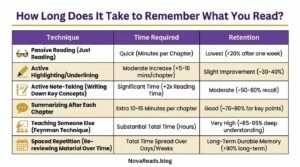
| Technique | Time Required | Retention Improvement |
|---|---|---|
| Read with a pen | 0 extra minutes | High |
| One sentence per chapter | 2 minutes per chapter | Very High |
| Teach it to someone | 10 to 20 minutes | Very High |
| 3 sentence summary | 5 minutes per book | High |
| Spaced repetition review | 5 minutes per session | Extremely High |
| Apply one idea | Varies | Highest |
FAQ
Why do I forget what I read so quickly?
Because passive reading produces passive retention. Reading without writing, connecting, or retrieving produces a vague impression that fades within days. The forgetting curve identified by Hermann Ebbinghaus shows that without active review, most people forget 70% of new information within 24 hours. Active reading techniques interrupt that forgetting process.
Does reading speed affect how much you remember?
Yes — but not in the way most people think. Reading faster through easy sections is fine. Reading faster through dense or complex sections reduces retention significantly. The key is to vary your pace based on the difficulty of the material rather than reading at a uniform speed throughout.
Is it better to take notes while reading or after?
Both work. Notes taken while reading capture immediate reactions and questions. Notes taken after reading capture synthesis and overall impressions. The most effective approach combines both: brief notes while reading plus a short summary immediately after finishing each chapter or the whole book.
How many times should you read a book to remember it?
Once, if you use active reading techniques. Rereading the same book passively is less effective than reading it once actively and reviewing your notes using spaced repetition. The exception is books so dense or important that a second active reading reveals ideas invisible in the first.
Does listening to audiobooks help you remember as much as reading?
Research shows minimal difference in retention between reading and listening for most book types. The key variable is engagement level not the format. An audiobook listened to actively, with pauses to note ideas, produces similar retention to a physical book read with a pen.
What is the best note-taking method for books?
Writing one sentence per chapter in your own words is the most efficient method for most readers. More elaborate systems Cornell notes, zettelkasten, mind maps work for some readers but create enough friction that many people abandon them. The best note-taking method is the one you will actually use consistently.
How do you remember non-fiction books better than fiction?
Non-fiction retention improves most from writing chapter summaries and applying specific ideas. Fiction retention improves most from discussing the book with others and writing about the themes and characters rather than the plot. The underlying principle is the same: active engagement produces memory, passive consumption does not.
Should you reread books you enjoyed?
Rereading books you found valuable is worth doing but only after your notes from the first reading have been reviewed using spaced repetition. Rereading before that review wastes the opportunity to discover what you retained and what you forgot, which is the most useful information a rereading can give you.
How do you build a reading habit that improves retention?
Combine daily reading with a consistent note-taking practice. The habit is not just reading it is reading plus capturing. Twenty pages with a pen and one sentence of notes per chapter produces more retention than 100 pages read passively. Start small and add the note-taking component before increasing your page count.
What should you do immediately after finishing a book?
Write your 3 sentence summary before doing anything else. Then review your chapter notes once. Then schedule a review in 3 days using your notes. These 3 steps done in 15 minutes immediately after finishing determine whether you remember the book for years or forget it within weeks.